We report in numbers
Not "this should improve things," but "contact resistance down 0.15 K/W, junction temperature (Tj) down 3.2°C." The boundary conditions and assumptions behind that number come with it.

About
We do not manufacture or resell thermal components. Having no stake in a particular part or process is exactly what lets us propose the structure that fits your performance, space, and cost targets — and say so plainly.
Thermal problems are not solved at any single stage. A great simulation result means nothing if no process can produce that geometry, and a good prototype means nothing if production conditions don't reproduce it.
So we provide both the judgment and the execution. We set direction with simulation, find suppliers who can actually build it, verify in hardware, and carry the design through to production conditions. For you, that is one point of contact instead of four.
Because we are not tied to any thermal component maker, we will tell you plainly when a heat pipe is the answer — and when a single graphite sheet is enough.
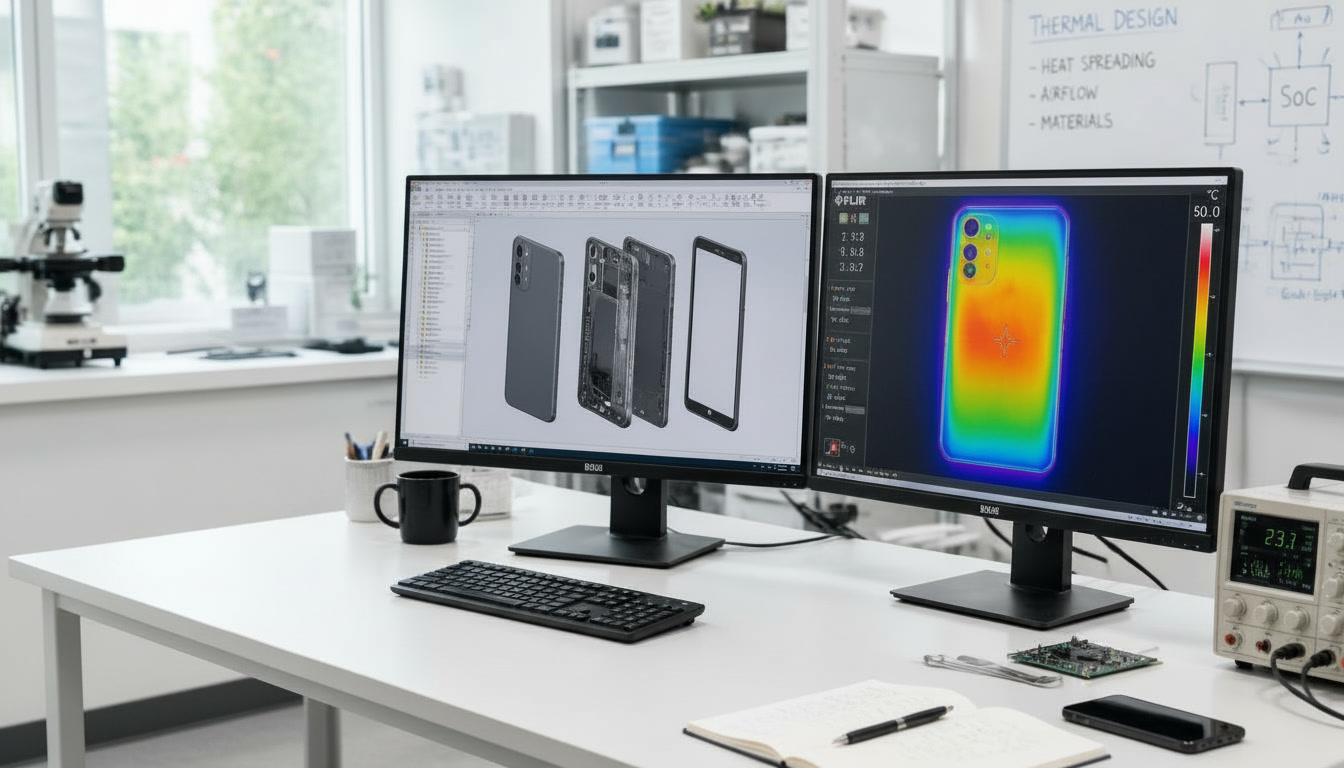
Not "this should improve things," but "contact resistance down 0.15 K/W, junction temperature (Tj) down 3.2°C." The boundary conditions and assumptions behind that number come with it.
Thickness (Z-height), weight, target BOM cost, fan acoustics, production volume. A simulation run without knowing these produces results nobody can act on. We define constraints before kickoff.
We do not leave a gap between simulation and measurement unexplained. We tune the model against prototype data, and only a correlated model gets reused on the next derivative programme.
We don't propose geometry that can't be made. Tolerances, assembly sequence, and inspection method are part of the design proposal.
Take only the scope you need. We have noted when each model fits.
A single simulation and report on a specific design. Fits when your analysis queue is backed up and you need outside capacity for one job.
Full participation from concept through design freeze. Fits a new programme where the thermal architecture has to be set from scratch. Weekly reviews alongside your design team.
Supplier selection, process condition definition, and first-run attendance. Fits when development is done and only the production transfer remains.
Fits customers running several models in parallel who need standing advice. Priority response and scheduled reviews.
Share heat load, form factor, target temperature, schedule. NDA in place.
Constraints documented, deliverables and milestones fixed, quotation issued.
Design, simulation, and build. Weekly or milestone-based reviews.
Reports, drawings, specifications, and the native simulation models — all handed over.
Production transfer or support for derivative models as needed.
No CAD data or 3D model required. Share heat load (W), form factor, and target temperature (°C), and we will come back within two business days with an approach and an estimated lead time.