How far can air cooling go — and where liquid takes over
"How many watts can air handle" has no answer. Convert heat flux and allowable temperature rise into a required heat transfer coefficient, and check what to settle before switching.
“How many watts can air handle?” is a question we get often, and it cannot be answered. Spread 100W over a large area and air is plenty. Concentrate 5W on a tiny die and air struggles.
What decides the answer is not watts. It is heat flux and allowable temperature rise.
Convert it into a required heat transfer coefficient
Heat leaving a surface into air (or liquid) is written with Newton’s law of cooling.

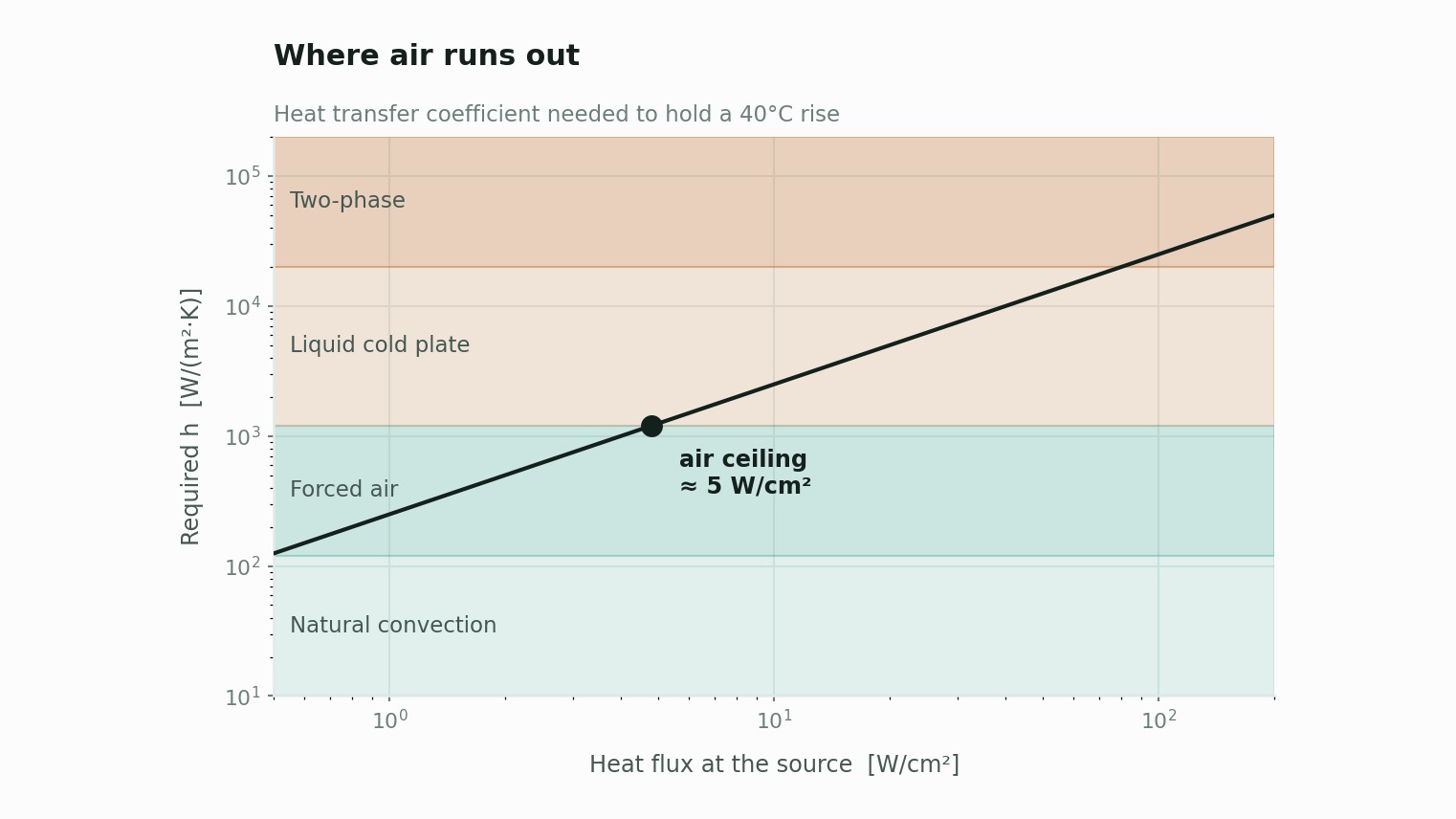
Now invert what you need. Given heat flux q″ and allowable temperature rise ΔT, the required coefficient is q″/ΔT. The criterion is whether that value falls inside the range a given cooling method can actually deliver.
Rough ranges:
| Method | h [W/(m²·K)] |
|---|---|
| Natural convection (air) | 5 – 25 |
| Forced convection (air) | 25 – 250 |
| Single-phase liquid | 500 – 15,000 |
| Two-phase (boiling) | 5,000 – 100,000 |
A heat sink does not raise h; it raises effective h by adding area. So the air-side equivalent h in a real system comes out well above the table. But adding area runs into volume and pressure drop.
The practical ceiling for air
Allowing for volume and acoustic constraints, the practical ceiling sits around an effective h of roughly 1,000 W/(m²·K). Assume 40K of allowable rise and that lands near 4–5 W/cm² of heat flux.
Past that point air cooling gets expensive fast. Bigger fans raise noise; tighter fins raise pressure drop steeply.
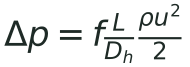
The important part is that dynamic pressure goes as velocity squared. Double the airflow and pressure drop quadruples, and fan power rises faster still. The limit of air cooling is usually an acoustic and power limit, not a heat transfer limit.
Liquid adds a resistance that air did not have
Liquid-side h is two to three orders of magnitude above air.
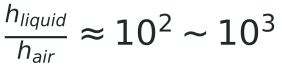
But switching on the strength of h alone fails. Liquid cooling introduces a term air cooling never had — the caloric resistance from the fluid warming up as it absorbs heat.
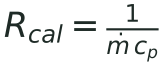
If flow rate is short, the outlet end runs hot no matter how good the cold plate is. When several heat sources sit in series and the last one misses spec, this is usually why. That is a flow rate or plumbing topology problem, not a cold plate problem.
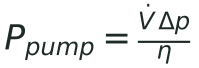
And pump power becomes a new cost and acoustic line item.
Four things to settle before switching
1. Is heat flux genuinely high, or is total power just large?
High total power spread over a large area is fine on air. These two get conflated more often than not.
2. Can spreading solve it?
Putting a vapor chamber over the source can bring heat flux back down into the air-cooling regime. This is the cheapest fix available. Check it before evaluating liquid.
3. Is the real constraint temperature, or noise?
If noise is the constraint, liquid is an excellent answer — you can remove the fan or shrink it substantially. In that case liquid is justified even when air would work thermally.
4. Can you carry the reliability and service cost?
Leakage, corrosion, fluid degradation, coupler life, and field service procedures all appear as new concerns. In consumer electronics this item decides the outcome more often than thermal performance does.
Summary
The order:
- Calculate heat flux, not total power
- Divide by allowable rise to get the required h
- If that h is inside the air range, stay on air
- If it is outside, first ask whether spreading can lower the heat flux
- If not, evaluate liquid — and design caloric resistance and pump power alongside it
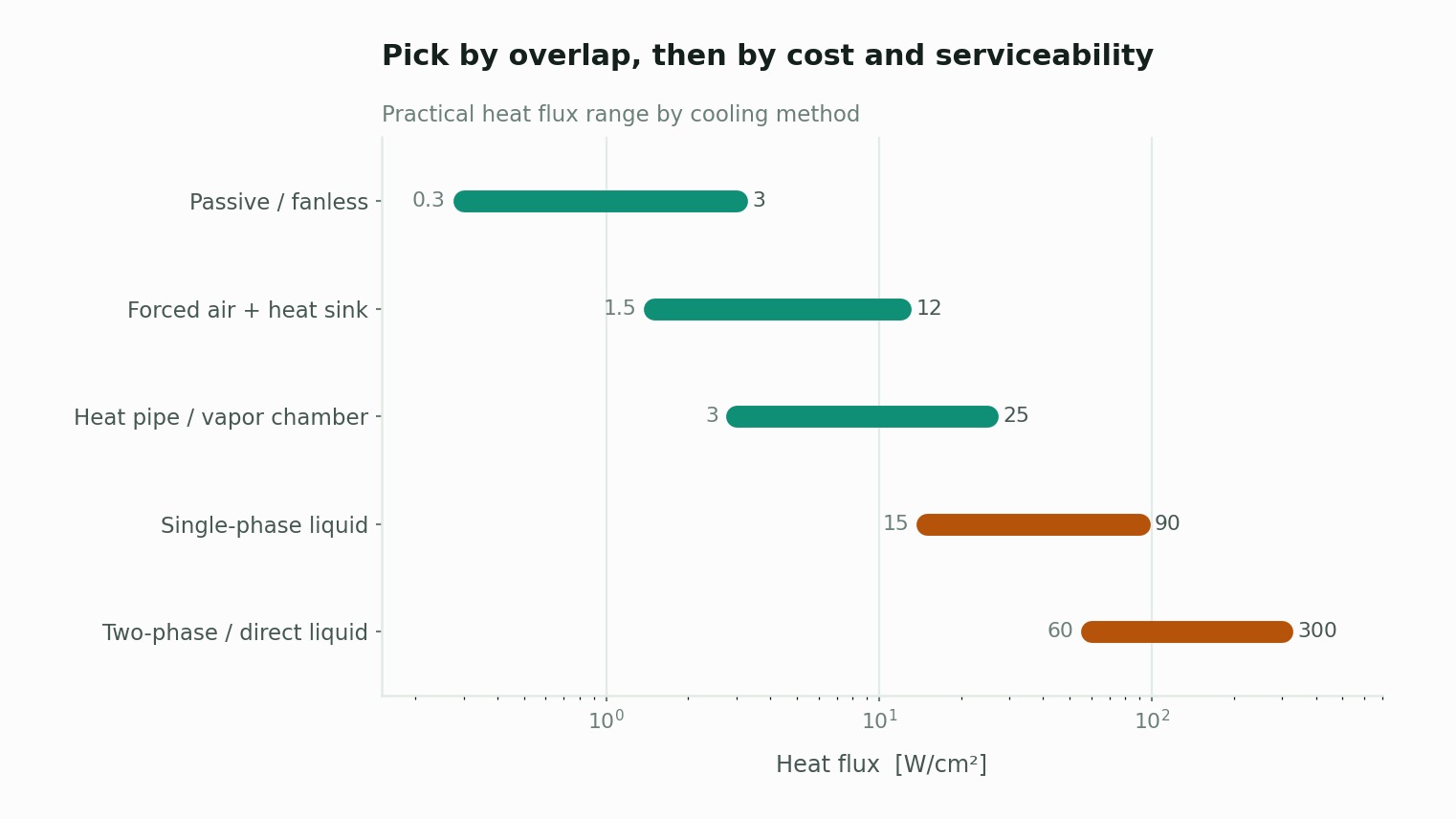
Where the ranges overlap, both work thermally. The choice in that band is about cost, volume, noise, and serviceability, and simulation will not answer it for you.
If you need help selecting a cooling approach or assessing a move to liquid, get in touch.